← Thought LeadershipThought Leadership
Are You a Gatekeeper or a Gate Opener?
 Rom Krupp · November 5, 2026 · 4 min read
The Hidden Cost of Protecting the Status Quo
Every organization has people responsible for protecting its time, money, and resources.
That’s important.
But somewhere along the way, protecting the business can turn into protecting the status quo.
And there’s a difference.
A gatekeeper looks for reasons an opportunity won’t work. A gate opener looks for reasons it might be worth exploring.
Neither should automatically say yes.
But only one is willing to ask the next question.
Consider three familiar excuses.
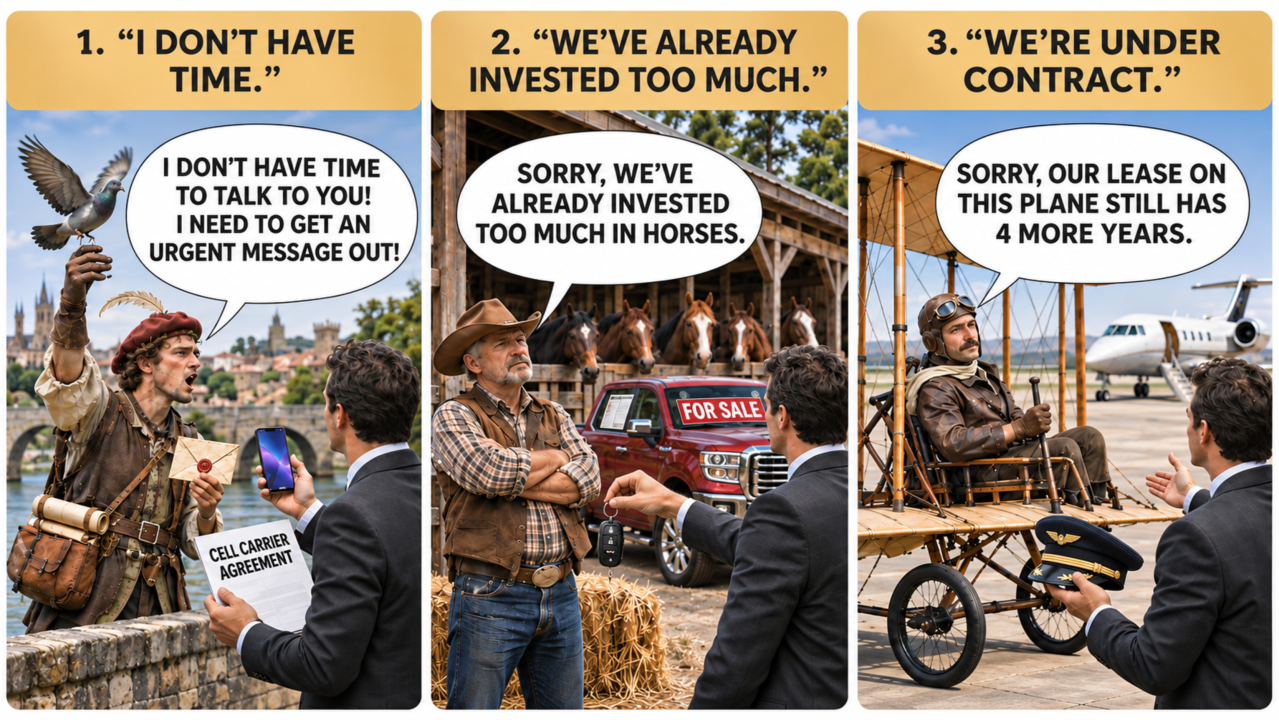
1. “I Don’t Have Time.”
Imagine someone rushing to send an urgent message by carrier pigeon.
A salesperson approaches and offers a mobile phone.
“I don’t have time to talk. I have to get this message out!”
It’s funny because we know how much faster the phone could be.
But organizations do this every day.
They’re too busy working around inefficient processes to investigate something that might eliminate those processes altogether.
Being busy isn’t evidence that an opportunity lacks value.
Sometimes it’s evidence that the opportunity deserves a closer look.
If you’re too busy to explore a better way of doing something, how will you ever find the time to improve?
2. “We’ve Already Invested Too Much.”
Picture a business with a large stable of horses.
Someone offers them a 400 horse power pickup truck.
“Sorry, we’ve already invested too much in horses.”
The horses may still have value. They may even remain useful for certain jobs.
But the money already spent cannot determine whether the next investment makes sense.
That’s the sunk cost fallacy.
Organizations fall into this trap constantly.
They’ve invested millions in technology, infrastructure, training, and processes. So when something better comes along, the instinct is to defend that investment rather than evaluate the opportunity.
But yesterday’s investment shouldn’t dictate tomorrow’s decisions.
The money has already been spent.
The question isn’t whether the original decision was right or wrong. It may have been the best decision available at the time.
The question is whether it’s still the best decision today.
3. “We’re Under Contract.”
Imagine an airline still flying propeller aircraft when someone offers them a modern jet.
“Sorry, we have four more years on our lease.”
Contracts matter. Obligations don’t disappear because better technology comes along.
But here’s an important distinction:
A contract tells you what you’re obligated to pay. It doesn’t necessarily tell you what you’re obligated to use.
Suppose a company has four years and $400,000 in payments remaining on an existing technology contract.
Now suppose a new solution could deliver $2 million in operating improvements over those same four years.
Would you really dismiss that opportunity simply because you’re still under contract?
Of course, the decision requires proper financial analysis. You need to consider implementation costs, contractual obligations, transition risks, and the cost of the replacement.
But refusing to even evaluate the alternative because of an existing contract could be far more expensive than changing.
And some costs are harder to quantify.
Four more years of frustrated employees.
Four more years of unnecessary operational inefficiencies.
Four more years of a compromised customer experience.
Four more years of competitors gaining an advantage.
The real question isn’t just, “What will it cost us to change?”
It’s also, “What will it cost us if we don’t?”
The Difference Between Protecting the Business and Protecting the Past
None of this means every new idea deserves a purchase order.
Not every salesperson has a better solution. Not every innovation delivers meaningful value. And not every change is worth the disruption.
That’s precisely why evaluation matters.
A gate opener doesn’t automatically say yes.
They ask questions. They challenge assumptions. They investigate the potential. They run the numbers. They consider the risks.
And sometimes, after doing all that, they say no.
That’s good judgment.
A gatekeeper, on the other hand, often says no before the evaluation even begins.
Not necessarily because the opportunity lacks merit, but because exploring it would require time, effort, or a willingness to question decisions already made.
And that’s where organizations can get into trouble.
Over time, the accumulation of these decisions can create a culture where maintaining the status quo becomes more important than improving the business.
Where existing investments are defended rather than challenged.
Where contracts become excuses rather than financial considerations.
Where being too busy to improve becomes a permanent condition.
The greatest risk to a business isn’t always making the wrong decision. Sometimes it’s refusing to reconsider a decision when better alternatives become available.
Innovation doesn’t require saying yes to everything.
It requires being willing to question what you’re already doing.
And perhaps that’s the most important distinction of all.
A gatekeeper protects yesterday’s decisions. A gate opener protects tomorrow’s opportunities.
So here’s a question worth asking yourself:
When was the last time you turned down an opportunity because it genuinely wasn’t right for the business, rather than because exploring it was inconvenient?
So, are you a gatekeeper or a gate opener?
Originally published on LinkedIn.