← Thought LeadershipThought Leadership
From Bowling Alone to Dining Alone
 Rom Krupp · October 14, 2026 · 6 min read
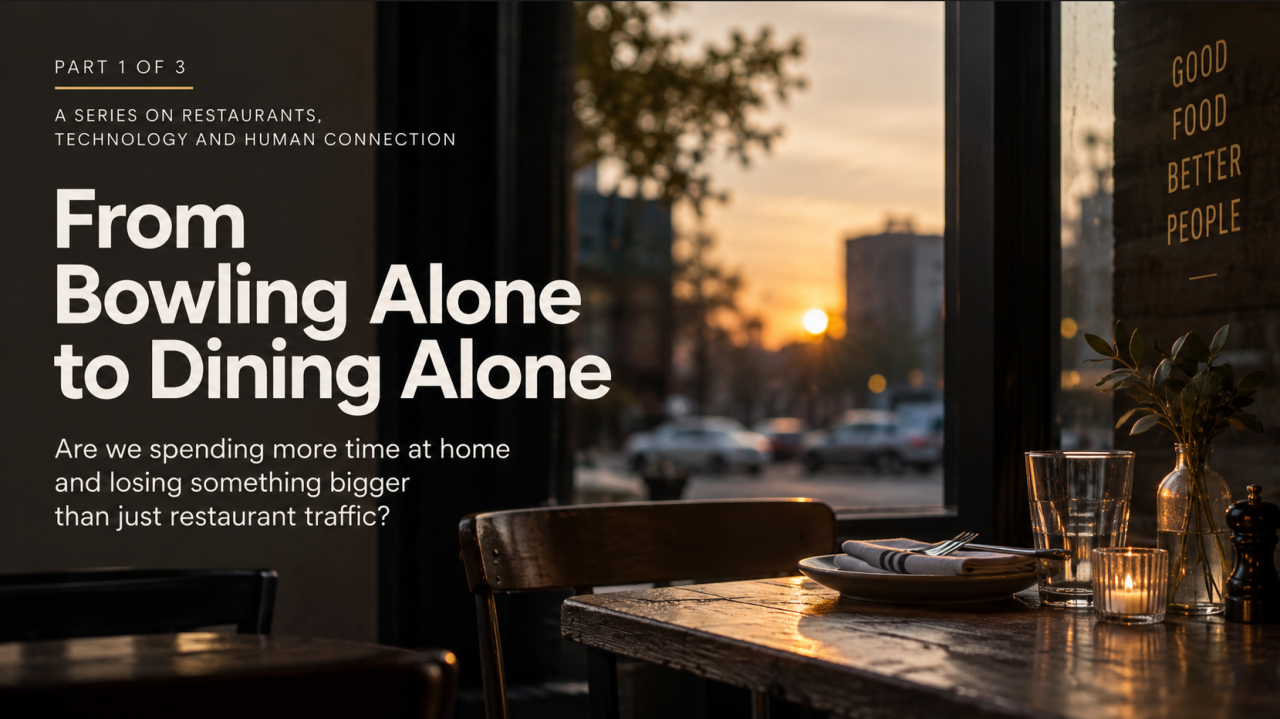
Part 1 of a three-part series on restaurants, technology and human connection.
I’ve been thinking a lot about restaurant traffic lately.
We talk about inflation, menu prices, labor, delivery, consumer confidence and changing spending habits. All of those things matter. But I wonder if something much bigger is happening that has very little to do with restaurants.
What if people are simply becoming more comfortable not going out? Not just to restaurants. Anywhere.
In 2000, Harvard professor Robert Putnam published Bowling Alone, which documented the decline of social participation in America. The title came from a simple observation. Americans hadn’t stopped bowling. They had stopped joining bowling leagues. Putnam connected that to a much broader decline in participation in clubs, community organizations, civic groups and other activities that historically brought people together.
That was 26 years ago. Think about what’s happened since.
Amazon eliminated a lot of our need to go shopping. Streaming eliminated a lot of our need to go to the movies. Remote work eliminated the commute and, for many people, the office. Grocery delivery eliminated another trip. Restaurant delivery eliminated another. Banking moved to our phones. Even a lot of our social interaction moved to a screen.
None of these things are bad individually. I use most of them. But put them together and we’ve done something pretty remarkable. We’ve built a world where you can participate in a huge part of daily life without actually participating in public life.
And there is data behind it. In a 2024 study titled Homebound: The Long-Term Rise in Time Spent at Home Among U.S. Adults, Princeton sociologist Patrick Sharkey found that Americans spent an average of 1 hour and 39 minutes more at home each day in 2022 than they did in 2003. That’s almost 12 additional hours every week. COVID certainly accelerated the behavior, but the research shows the shift toward spending more time at home started well before the pandemic.
Then look at eating. The 2025 World Happiness Report found that about 26% of American adults ate every meal alone on the day surveyed in 2023. That’s an increase of more than 50% compared with 2003.
That’s what really got my attention. We haven’t stopped eating. We’re increasingly eating alone. And I wonder if that’s the modern version of Putnam’s bowling league.
We Keep Removing Friction
One of the most important words in technology over the last 20 years has been “friction.” We obsess over removing it. Order ahead. Contactless. Skip the line. Instant delivery. Don’t talk to anyone if you don’t want to. Don’t even leave the house.
I’ve spent most of my career in restaurant technology, so I’m certainly not against making things easier. Technology has eliminated an enormous amount of unnecessary friction. But lately I’ve been wondering: was some of that friction actually doing something useful?
Going to the grocery store wasn’t just about buying groceries. Going to work wasn’t just about producing work. Going to a restaurant wasn’t just about consuming calories. Those activities forced us into the world. We encountered people. Most of those encounters meant absolutely nothing. You talked to the cashier. You recognized someone at the bar. You saw a neighbor. You exchanged two sentences with somebody standing next to you.
But multiply those insignificant interactions across hundreds of millions of people, every day, for decades. Maybe they weren’t insignificant.
We Optimized for Convenience. What Did We Trade for It?
This isn’t an argument that everyone should stop ordering DoorDash and go sit in a restaurant. That’s not realistic, and I don’t think that’s the point.
The interesting question is what happens when convenience becomes the default behavior across almost every part of our lives. Every individual decision makes sense. Why drive to the store when Amazon can deliver it? Why commute if I can work from home? Why go to the theater if the movie is streaming? Why go out for dinner if the food can come to me?
But sociology isn’t about one person making one decision. It’s about what happens when millions of us make the same decision. And that’s where I think this gets interesting.
Have we become so good at eliminating the inconvenience of leaving home that we’ve also started eliminating the reasons to interact with each other? If we have, declining restaurant traffic may be one small symptom of a much bigger societal shift.
The question I’m interested in isn’t whether people are spending more time at home. The data suggests they are. The question is what that does to us over 10, 20 or 30 years. That’s where the research gets much more interesting. I’ll get into that in Part 2.