← Thought LeadershipThought Leadership
The Human Cost of Eating Alone
 Rom Krupp · October 15, 2026 · 6 min read
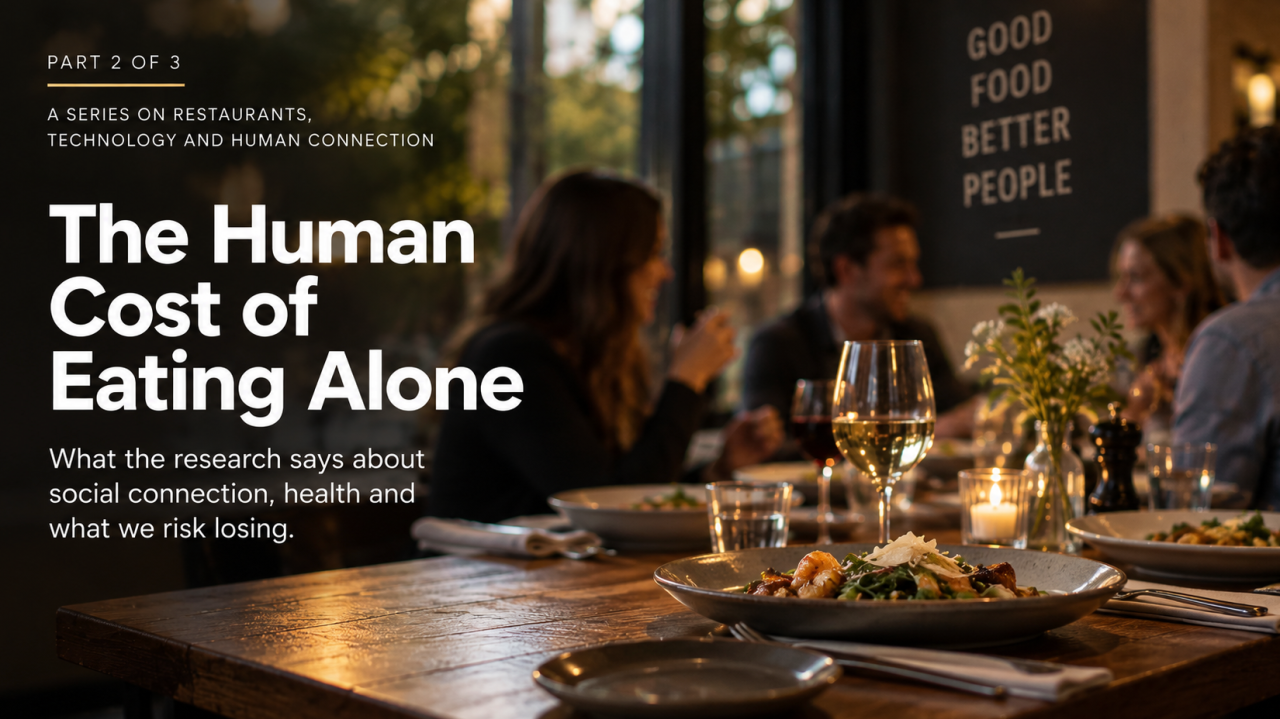
Part 2 of a three-part series on restaurants, technology and human connection.
In Part 1, I asked whether declining restaurant traffic might be part of something much bigger. Americans are spending more time at home. We’re increasingly able to work, shop, entertain ourselves and eat without leaving the house. The next question seems pretty obvious. Does it matter?
I started digging into the research expecting the answer to mostly be about loneliness. It’s more complicated than that.
First, eating at home isn’t the problem. A family sitting around a kitchen table talking for an hour may be having a far more meaningful social experience than four people sitting in a restaurant staring at their phones. And being alone isn’t the same thing as being lonely. Some people enjoy solitude. So I don’t think the argument is “eating alone is bad.” The more interesting issue is what happens when regular human interaction starts disappearing from everyday life.
Social Connection Is More Important Than I Realized
In 2023, the U.S. Surgeon General issued an extensive advisory on social connection and loneliness. One statistic immediately stood out to me. Social isolation has been associated with a 29% increased risk of premature mortality. The advisory also reviews research linking poor social connection with higher risks of cardiovascular disease, stroke, depression, anxiety and dementia.
Obviously, that does not mean eating dinner alone causes heart disease. That’s exactly the kind of leap I don’t want to make. But there is a much larger body of research suggesting that social connection matters to human health in ways we probably don’t think about very often.
Then I started looking specifically at meals. The 2025 World Happiness Report examined meal sharing across more than 140 countries and territories. People who shared more meals with others reported greater life satisfaction and more positive emotions. The relationship between meal sharing and subjective well-being was comparable in magnitude to some variables we spend enormous amounts of time discussing, including income and employment.
Again, correlation isn’t causation. Maybe happier people have stronger social networks and therefore eat with others more often. Maybe eating together contributes to happiness. Most likely there are multiple things happening at once. But either way, there seems to be a meaningful relationship between sharing food and sharing life.
Think About How Much of Life Happens Around Food
This part doesn’t really require research. Think about your own life. First dates. Birthdays. Weddings. Family dinners. Business meetings. Catching up with an old friend. Celebrating a promotion. Meeting someone for coffee. Holiday dinners.
A lot of our most important conversations happen around food. Why? Maybe food isn’t really the important part. The meal gives us a reason to sit across from another person long enough for something else to happen. We talk.
And increasingly, we’ve separated the food from the interaction. Delivery does an incredible job of getting the food to us. It just doesn’t deliver the conversation that used to come with it.
What Happens When This Becomes Generational?
This is the part I find most interesting. I’m old enough to remember life before the internet, smartphones, social media, streaming, Amazon, DoorDash, Zoom and remote work. Younger generations aren’t.
Think about how many interactions that used to require talking to another person no longer do. Ordering food. Buying something. Getting directions. Checking into a hotel. Banking. Customer service. Buying a movie ticket. Even asking a question is increasingly something we do with AI instead of another person.
Again, individually, I like most of these innovations. But what happens when an entire generation grows up with significantly fewer routine face-to-face interactions? I don’t know. And I don’t think anyone can honestly claim to know yet. But I think it’s a question worth asking.
There May Be a Reverse Network Effect
Technology people love network effects. The more people who use a network, the more valuable it becomes. I wonder if physical communities have the same effect in reverse.
A restaurant with people in it feels alive. A downtown with people walking around feels alive. A coffee shop full of people feels alive. A neighborhood where people know one another feels different from one where they don’t.
Now run the network effect backward. Fewer people go out. Businesses lose traffic. Some close. There are fewer places to gather. The area becomes less interesting. So even fewer people go out. At some point this stops being a restaurant traffic problem. It becomes a community problem.
Maybe Not All Friction Is Bad
We’ve spent decades designing technology around a very reasonable idea: make everything easier. But I’m starting to think “easier” and “better” aren’t always the same thing.
Maybe some of the things we considered friction were actually creating opportunities for interaction. Maybe occasionally having to show up has value. And if that’s true, restaurants may have a much bigger role in this conversation than our industry realizes. Because restaurants are still one of the few places where people regularly choose to leave their homes for the specific purpose of sitting together.
Which raises another question. What business are restaurants actually in? I want to tackle that in Part 3.