← Thought LeadershipThought Leadership
Loyalty Should Be a Check-In, Not a Checkout
 Rom Krupp · November 10, 2026 · 5 min read
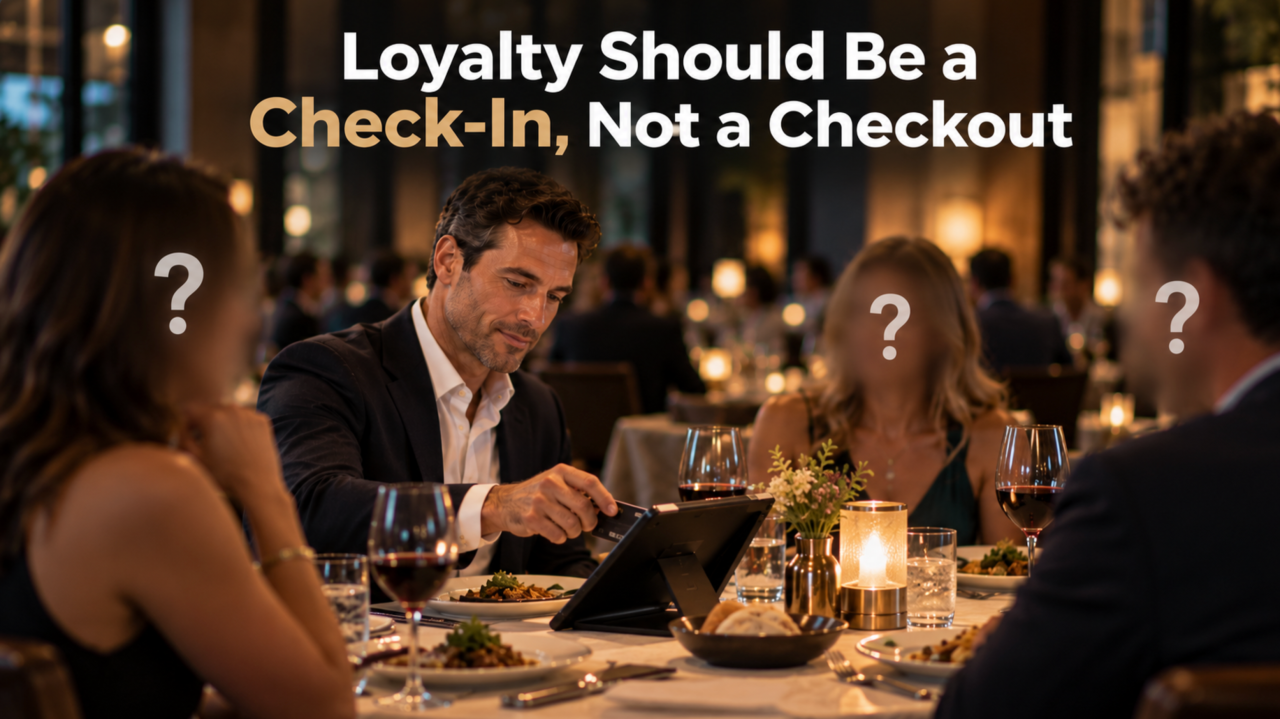
Full-service restaurants have spent years building loyalty programs designed to recognize guests.
There’s just one problem.
Most of them don’t recognize the guest until they’re about to leave.
And even then, they usually recognize only one person at the table: the person who pays.
Four people walk into your restaurant and sit down for dinner. All four could be loyalty members. All four are customers. All four have a history with your brand.
But at the end of dinner, one person pays.
That person enters their phone number, scans their loyalty account, earns the points and gets attached to the transaction.
Great.
But what happened to the other three?
They ate at your restaurant too. But they don’t feel seen or recognized.
We Know Who Paid. We Don’t Necessarily Know Who Came.
Let’s say I eat at one of my favorite restaurants three times this month.
The first time my wife pays. The second time I’m with a friend who picks up the check. The third time I’m at a business dinner and someone else pays.
I have now visited that restaurant three times.
But according to loyalty data, I may not have visited at all.
Eventually, the system could decide I’m a lapsed guest and send me an offer saying: “We miss you!”
I was there yesterday.
You don’t really know your customer. You only know who paid.
And there is a huge difference between the two.
We Took a Counter-Service Model and Applied It to Full Service
When you look at how restaurant loyalty evolved, it’s not hard to understand how we got here.
In counter service, the person ordering is generally the person paying.
One customer. One order. One transaction.
Identifying the customer as part of the transaction makes sense.
But full service doesn’t operate that way.
You might have two, four, six or eight individual guests sitting at a table, each with their own relationship with your brand.
Yet we took a loyalty model built around a transaction and applied it to a completely different operating model, without really changing the thinking behind it.
And we’re leaving a tremendous amount of value on the table because of it.
What If Loyalty Happened at Check-In?
Instead of waiting until payment, what if we identified loyalty members when they sat down?
Not just the reservation holder.
Not just whoever eventually pays.
Every loyalty member at every seat.
Imagine the server knowing that the guest in seat 2 usually orders the salmon.
Seat 3 is vegetarian.
Seat 4 loves a certain Cabernet.
Someone attended one of your wine dinners.
Someone has been to your restaurant 15 times this year.
Someone has a birthday coming up.
That information has value right now, while the guest is sitting in your restaurant.
And that’s where the real opportunity is.
Of course, the first question operators will ask is: How does this work without slowing down seating or giving servers another task?
It shouldn’t.
Check-in could happen through a reservation, a simple QR code at the table, a guest’s phone or a quick interaction with the server’s handheld. Guests could identify themselves voluntarily, with their preferences linked to their seat. No new line at the host stand, no mandatory process and no reason to interrupt service. The technology should fit into the restaurant’s existing workflow, not create another one.
The point isn’t how guests check in. It’s that we give them the opportunity to be recognized before the experience is over.
Loyalty Should Help Create the Experience
We’ve spent years using loyalty to answer:
What can we give this person to get them to come back?
Points. Discounts. Offers. Free items.
Those things have value. I’m not suggesting restaurants should stop doing them.
But what if loyalty also answered a much more important question:
What should we know about this guest that offers them a better experience while they’re here?
A great bartender doesn’t need a loyalty program to remember your drink.
A great server recognizes a regular and remembers what they like.
A great restaurant remembers you.
Technology should help all three do that at scale.
Instead, your technology waits until the guest is ready to leave, asks for a phone number and gives them points.
The Data Problem Is Bigger Than It Looks
This isn’t just about hospitality.
It’s also about the quality of the data we’re building everything else on top of.
Having spent more than a decade building restaurant analytics and predictive models at Red Onion AI, formerly Marketing Vitals, I can tell you that the quality of the underlying data matters enormously.
We can build increasingly sophisticated models around guest frequency, lifetime value, churn, menu affinity and purchasing behavior.
But what happens when the underlying guest identity is incomplete?
If we only identify the person paying, how accurate is our understanding of frequency?
How accurate is lifetime value?
How accurate is churn?
How accurate are lapsed-guest campaigns?
A guest could be one of your most frequent customers and look inactive simply because they don’t usually pick up the check.
And there’s another issue. If one person pays for four people, we may associate the entire transaction with that person, including items they never ordered.
Now we’re potentially distorting not just visitation frequency, but individual menu preferences and purchasing behavior.
The more sophisticated our analytics become, the more important it is that we understand who actually visited and what they actually ordered.
And if we’re going to use AI to make decisions about our guests, shouldn’t we start by making sure we know who those guests are?
From Rewards to Recognition
I don’t think the future of loyalty is about eliminating rewards.
It’s about making loyalty mean more than rewards.
There is a huge difference between knowing a transaction and knowing a guest.
And there is an even bigger difference between using what you know about someone after they leave versus using it to make their experience better while they’re there.
For full-service restaurants, loyalty shouldn’t begin at the end, with the check and the payer.
It should start in the beginning, with every guest in the party.
Move loyalty from checkout to check-in.
Know every guest at the table, not just the one who picked up the tab.
Because the real opportunity isn’t just rewarding their next visit.
It’s making this visit better.
Originally published on LinkedIn