← Thought LeadershipThought Leadership
The Product Was Bigger. The Customer Thought It Was Smaller.
 Rom Krupp · October 12, 2026 · 4 min read
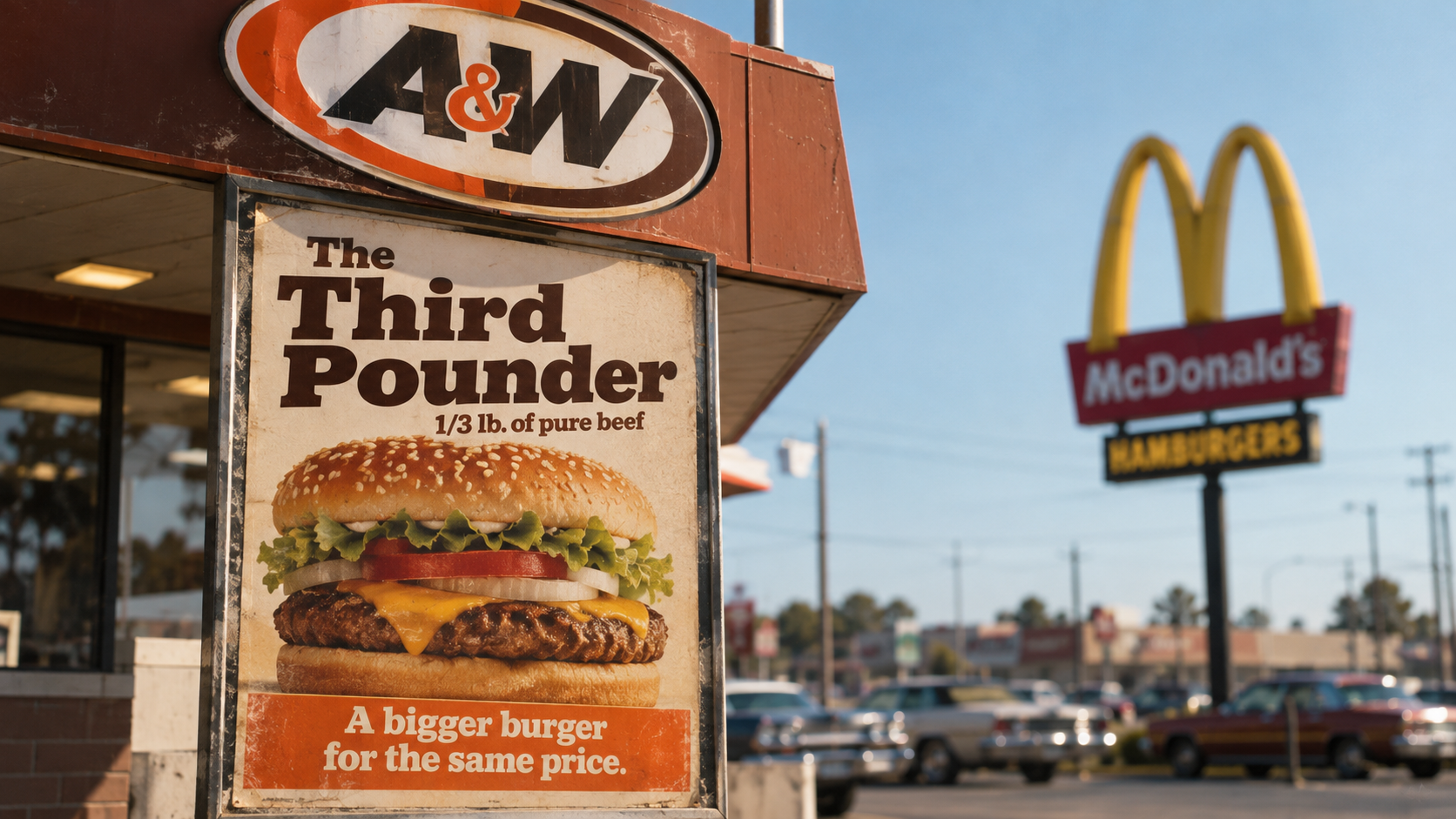
There is an old A&W story that sounds almost too perfect to be true.
Except the core of it actually is.
In the 1980s, A&W was trying to compete with McDonald’s Quarter Pounder.
A&W introduced a one-third-pound hamburger.
The proposition seemed pretty straightforward: 1/3 of a pound is larger than 1/4 of a pound. A&W was offering more meat at essentially the same price.
But the burger wasn’t selling.
According to A. Alfred Taubman, who owned A&W at the time, the company brought in a market research firm to understand why.
What they found is one of my favorite lessons in business.
In the focus groups, the majority of participants incorrectly believed that one-third of a pound was smaller than one-quarter of a pound.
Their logic was simple.
Four is bigger than three.
Therefore, 1/4 must be bigger than 1/3.
Of course, mathematically, the opposite is true.
A&W had built the larger burger. But some customers perceived it as the smaller one.
A&W itself has since documented the story, based on Taubman’s account in his book Threshold Resistance. His takeaway was essentially that the messages companies send customers are not always as clear or compelling as the companies believe they are.
That lesson goes far beyond hamburgers.
More than 50% of product launches miss their targets
In 2017, McKinsey published research on product and service launches.
One statistic stood out:
More than 50% of all product launches fail to hit their business targets.
That is especially interesting because McKinsey also reported that more than 25% of total revenue and profits across industries came from new product launches.
In other words, companies depend heavily on launching new things, yet a huge percentage of those launches fail to deliver what was expected.
McKinsey’s research points to several factors separating successful launches from unsuccessful ones, including establishing a launch strategy early, putting the right governance in place, investing in market insights and using data to monitor performance after launch.
But I think the A&W story illustrates something even more fundamental:
A product can make perfect sense inside the company and still make no sense to the customer.
Those are two very different tests.
We tend to test whether the product works
When we develop something new, we naturally focus on the product.
Does it work?
Is it faster?
Is it cheaper?
Does it perform better?
Will customers like it?
Can we demonstrate an ROI?
All important questions.
But there is another question that may be just as important:
Will the customer understand what we think we are telling them?
A&W knew that 1/3 was larger than 1/4.
The product team knew it.
The marketing team knew it.
Management knew it.
Mathematically, it was indisputable.
None of that mattered if the customer interpreted the message differently.
That is the part I think businesses underestimate.
Customers don’t experience our strategy
They experience the few words, images, prices and choices we put in front of them.
We may have spent six months building the product.
They may give us six seconds.
We may understand every reason a feature is valuable.
They see a button.
We may understand an entire pricing model.
They see $49 versus $59.
We may know why our product is objectively better.
They only know whether we made that advantage obvious.
That gap between what we know and what the customer perceives can destroy a very good idea.
Test the interpretation, not just the product
This is where I think the A&W story remains relevant more than 40 years later.
When testing a new product, feature, pricing model or business concept, don’t just ask:
Do people like it?
Ask:
What do you think this means?
Those questions test two completely different things.
Give the proposition to someone who wasn’t involved in creating it.
Don’t explain it.
Don’t give them the backstory.
Don’t correct them.
Just watch.
What do they think they’re buying?
What do they think it costs?
What do they believe the advantage is?
What do they think happens next?
Then ask them to explain the product back to you.
Their answer may be much more valuable than asking whether they like it.
Somewhere in most companies is a Third Pounder
A feature that is technically better but sounds more complicated.
A pricing model that makes financial sense but looks more expensive.
A workflow that saves time once someone understands it, but feels harder the first time they see it.
A product name that means something completely different to customers than it does internally.
Or an innovation everyone inside the company considers obvious because they have been discussing it for a year.
The dangerous assumption isn’t necessarily that the product works.
It may be that the customer sees what we see.
A&W’s customer didn’t need a lesson in fractions.
A&W needed a way to communicate the value that didn’t require one.
That distinction is worth remembering.
Because sometimes the product isn’t the problem.
Sometimes 1/3 really is bigger than 1/4, and you still lose.
Sources
McKinsey & Company, How to make sure your next product or service launch drives growth, October 13, 2017.
A&W Restaurants, The Truth About A&W’s Third-Pound Burger and the Major Math Mix-Up, April 16, 2021, recounting former A&W owner A. Alfred Taubman’s account in Threshold Resistance.