← Thought LeadershipThought Leadership
Maybe Restaurants Don't Really Sell Food
 Rom Krupp · November 3, 2026 · 5 min read
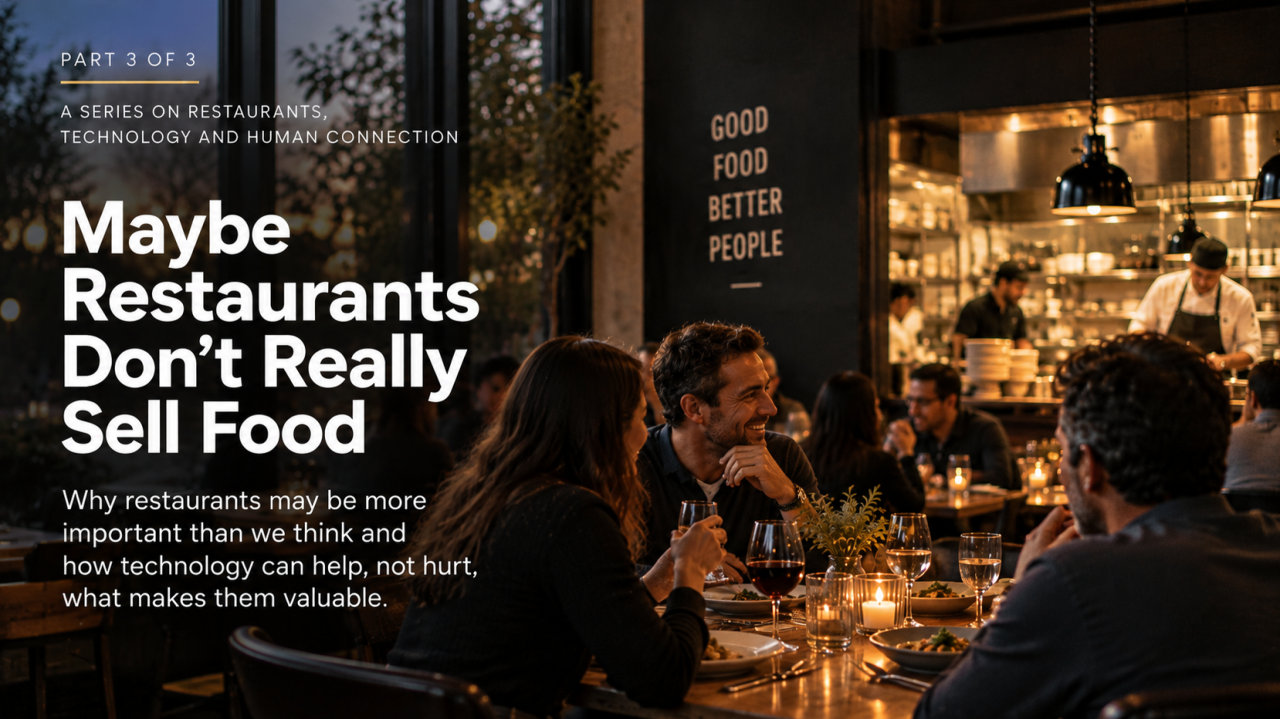
This is the third and final part of the Eating Alone series, following From Bowling Alone to Dining Alone and The Human Cost of Eating Alone.
I started this series thinking about restaurant traffic. I ended up thinking about what restaurants actually sell. And I’m increasingly convinced that we’ve defined our own industry too narrowly. Obviously, restaurants sell food. But if food were the entire product, eating at home would win almost every time.
Home is incredibly convenient. There’s no drive. No parking. No waiting for a table. No check to wait for. And thanks to delivery, you can now get restaurant food without the restaurant.
So why do people still go out?
I think the answer matters, especially as restaurant traffic continues to be challenged.
The Restaurant Is Part of the Product
Sociologist Ray Oldenburg popularized the concept of the “third place.” Home is the first place. Work is the second. Third places are the cafés, bars, restaurants and other informal places where people spend time around one another.
More recent research has expanded on the idea of these places as “social infrastructure”, the physical places that help create opportunities for social interaction. That phrase really stuck with me.
Social infrastructure.
We usually talk about a restaurant closing in economic terms. Revenue disappears. People lose jobs. A landlord loses a tenant. Tax revenue disappears. But something else disappeared too. A place where people met. And that is much harder to measure.
I Think Restaurant Technology Has to Be Careful Here
I’ve spent most of my career building technology for restaurants. For years, our industry has been focused on removing friction. Some of that friction absolutely should disappear. Waiting 15 minutes to pay your check isn’t hospitality. Making a server walk back and forth to a POS terminal all night isn’t hospitality. Making a guest repeat information you already know isn’t hospitality. Technology should fix those things. But there’s an important distinction that I think we sometimes miss.
Take paying the check. We’ve invested in technology that allows guests to pay whenever they’re ready, without waiting for their server. And that’s a good thing.
But why did we need that technology in the first place?
Because somewhere along the way, we became less attentive to our guests. We created technology to compensate for our own hospitality deficiencies. Instead of asking why a guest has to wait 15 minutes for their check, we built a way for them to bypass the server entirely.
That solves the immediate problem, but does it solve the underlying problem?
I’m not suggesting we should take that convenience away.
I’m suggesting that we need to recognize the difference between technology that improves hospitality and technology that compensates for the lack of it.
Removing friction and removing human interaction are not the same thing.
A server remembering your name isn’t friction.
A bartender knowing your drink isn’t friction.
A great server explaining a menu isn’t friction.
A genuine conversation isn’t friction.
Those things are hospitality.
Technology should remove the things that prevent employees from providing hospitality, not remove the hospitality itself.
And AI is going to make that distinction much more important.
AI Gives Restaurants a Choice
We’re entering an era where AI can automate huge portions of restaurant operations. Ordering. Recommendations. Payments. Scheduling. Training. Customer service. Marketing. And we’re only at the beginning.
As someone who spends a lot of time thinking about AI in restaurants, I think there are two very different directions this can go. We can use AI to remove people from the restaurant experience. Or we can use AI to remove the repetitive tasks that prevent people from being great at hospitality.
Those are fundamentally different strategies.
If AI can give a server instant product knowledge, reduce administrative work, eliminate unnecessary steps and allow that person to spend more time with guests, that’s technology increasing human interaction rather than replacing it.
I think that’s the opportunity.
Stop Trying to Beat the Couch
Restaurants have spent years competing with the convenience of eating at home. I don’t think we can win that competition. The couch is going to win. There’s no parking at the couch. Netflix is already there. Your dog is probably there. And nobody brings you a check.
So maybe convenience isn’t the battlefield. Maybe restaurants need to compete on the things home can’t easily reproduce. Energy. Atmosphere. Discovery. Celebration. Hospitality. Conversation. Connection.
The 2025 World Happiness Report found a strong relationship between sharing meals and subjective well-being. That’s not a restaurant statistic. But I think it’s incredibly relevant to restaurants.
Because restaurants are one of the few businesses whose product naturally creates an excuse for people to sit together.
Maybe Experience Isn’t Added to the Product
We talk constantly about the “guest experience.” Usually as though experience is something we add around the food. Good food plus good service plus good atmosphere equals a good experience. I’m beginning to wonder whether we’ve got that backward.
Maybe the experience is the product.
Food is what brings everyone to the table. Think about what restaurants actually facilitate every day. First dates. Birthdays. Anniversaries. Business deals. Family dinners. Reunions. Celebrations. Difficult conversations. Friends catching up. Someone sitting at a bar who doesn’t want to sit home alone.
Those moments aren’t ancillary to the restaurant business.
Maybe they are the restaurant business.
This May Become More Valuable, Not Less
Here’s the irony. As AI and technology make the rest of our lives increasingly digital, physical human experiences may become more valuable. If we work remotely, shop online, stream entertainment, order groceries, have meals delivered and increasingly interact with AI, there are simply fewer reasons to go somewhere.
Restaurants still give us one. That could make the social role of restaurants more important over time, not less. But only if we protect what makes going out different from staying home.
If we use technology to turn restaurants into physical versions of delivery apps, we may eliminate the very thing that makes them valuable.
If we use technology to eliminate operational friction and allow employees to spend more time creating hospitality, I think we have a very different future.
I started this series asking whether Americans staying home more could be contributing to declining restaurant traffic. After going through the research, I think I was asking the wrong question.
Maybe the question isn’t:
How do restaurants get people to eat out more often?
Maybe it’s:
How do we give people a reason to want to come together again?
Because perhaps the most important thing restaurants serve was never food.
But a reason to sit at the same table.
Originally published on LinkedIn.